Meta Description: Learn why the appraisal review process is a non-negotiable step for lenders, AMCs, and mortgage professionals and how it protects everyone at the closing table. Go Source Valuation blog.
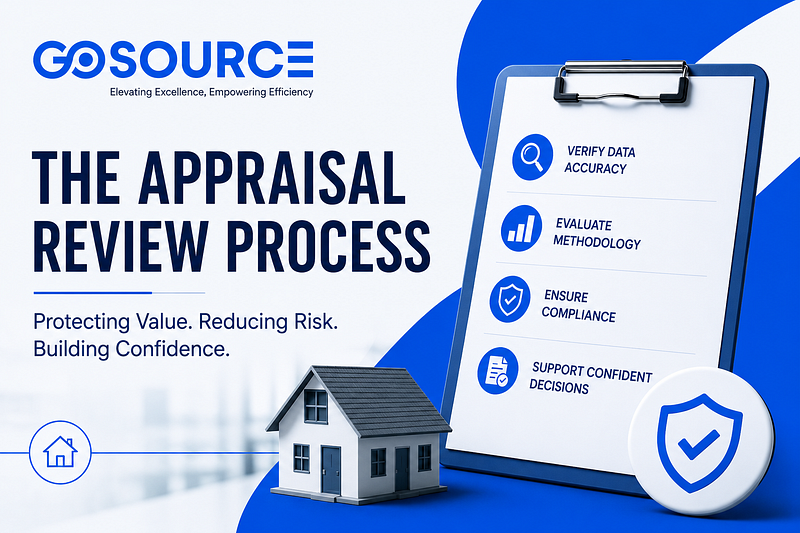
When a real estate transaction moves toward closing, everyone at the table, against the lender, the buyer, and the underwriter, is trusting one document to tell the truth about a property’s value. That document is an appraisal report. And the process that verifies whether it holds up is the appraisal review.
Most conversations in mortgage lending focus on origination speed, rate locks, and underwriting timelines. The appraisal review quietly does some of the most important work in the whole transaction, and yet it remains one of the least discussed steps among professionals outside of AMCs and quality control teams.
That gap in understanding is exactly where deals fall apart; buybacks happen, and regulatory scrutiny begins.
What an appraisal review! Does
An appraisal review is not a second opinion on value. It is a structured evaluation of whether the original appraisal report was prepared correctly, whether the appraiser used the right methodology, supported their adjustments with credible market data, and complied with applicable standards, including USPAP, Fannie Mae guidelines, and Freddie Mac requirements.
Think of it this way: the appraisal tells you what a property is worth. The appraisal review tells you whether you can trust the appraisal.
For lenders operating at volume, this distinction matters enormously. A report that looks clean on the surface can carry silent risks: unsupported comparable sales, adjustments that don’t reflect local market behavior, or compliance gaps that will surface during a post-close audit. A properly conducted appraisal review catches these issues before they become your problem.
The Five Types of Appraisal Reviews and When Each One Applies
Not all reviews are built the same. The type of review of a lender or AMC order depends on the transaction complexity, the loan type, and the level of risk involved.
Desk Review
The most used format in high-volume mortgage operations, a desk review is conducted without a physical property visit. The reviewer analyzes the appraisal report itself, examining the data sources, comparable sales selection, adjustment logic, and overall conclusions. It is fast, cost-efficient, and highly effective for standard residential transactions where the original report is reasonably well-prepared.
Field Review
When a transaction involves a higher-value property, an unusual market area, or a flagged discrepancy, a field review adds an exterior inspection and sometimes interior access to the review process. The reviewer physically verifies that the property details reported in the appraisal match what actually exists. Field reviews are slower and more resource-intensive, but they reduce exposure significantly on complex loans.
Narrative Review
A narrative review produces a detailed written analysis of the appraisal report, examining methodology, data integrity, and the logical soundness of the appraiser’s conclusions. This format is commonly required in legal disputes, high-stakes litigation, or portfolio-level due diligence, where a formal opinion on the original report’s credibility is needed.
Form review is
used extensively in AMC quality control workflows; a form of review applies to a standardized checklist to evaluate key aspects of the appraisal. It brings consistency to the review process, making it especially useful when a team is processing large volumes of reports and needs documented, repeatable QC results.
Compliance Review
This review zeroes in on regulatory alignment, USPAP standards, lender overlays, FHA or VA requirements, and GSE guidelines. It is the first checkpoint many AMCs run before releasing a completed report to the lender client, and it is often the layer that prevents the most common submission errors.
Understanding which review type a given transaction needs is itself a skill. Lenders who default to desk reviews across every loan type are leaving real risk on the table.
What Reviewers Are Actually Looking For
A qualified review appraiser is not reading a report, looking for reasons to reject it. They are reading it with a question in mind: Does this appraisal credibly support the value of the conclusion?
To answer that, they focus on several core areas. Data accuracy is the foundation. Property details, GLA, site size, and comparable sale information all need to hold up against public records and MLS data. Methodology matters too: did the appraiser apply the appropriate approach to value, and did they weigh it correctly for the property type and market? Adjustment logic is a common source of flags, particularly when dollar amounts are not supported by paired sales analysis or market extraction. And compliance issues, such as missing certifications, incorrect form of use, and scope of work gaps, can make an otherwise decent appraisal unsaleable on the secondary market.
The appraisal review process maps these elements systematically, producing a documented opinion of whether the original report is credible, needs revision, or requires a full replacement.
Why AMCs Are the Natural Home for Appraisal Review Operations
Appraisal management companies sit in a unique position in the lending ecosystem. They manage the appraiser panel, track order completion, and serve as the quality control layer between the originator and the completed report. Appraisal review is not an add-on for an AMC; it is core to what makes the AMC valuable to its lender clients.
When an AMC has a robust review operation, it means lenders receive reports that have already been checked against USPAP, against Fannie Mae and Freddie Mac standards, and against the specific overlays the lender has established. It means fewer revision requests, faster underwriting, and lower buyback risk on the back end.
AMCs that invest in their review capabilities, whether through internal review staff or outsourced review specialists, deliver a meaningfully different product than those that simply pass reports through and hope the underwriter catches any issues.
The Risk of Skipping the Review
Lenders who operate without a consistent appraisal review process are not saving time; they are borrowing it from their future selves. An inaccurate appraisal that funds a loan may not surface until post-close QC, an investor audit, or a repurchase demand. By that point, the cost of the problem is dramatically higher than any efficiency gained by skipping the review.
Regulatory scrutiny on appraisal quality has also intensified in recent years, particularly around fair lending concerns and the accuracy of valuations in underserved markets. Lenders need documented evidence that they applied consistent review standards to their appraisal workflow. A review process that is informal, inconsistent, or nonexistent creates exposure that is difficult to defend.
Building a Review Process That Actually Works
The most effective appraisal reviews of operations share a few characteristics. They have clear criteria for which review type is triggered by which loan or property conditions. They use qualified review appraisers who are either licensed in the relevant state or meet the competency requirements for the property type. They document every finding, whether the conclusion is that the report passes, needs correction, or requires a new assignment. And they track review outcomes over time to identify which appraisers on the panel are producing consistent, credible work and which ones are generating chronic issues.
That last element connects directly to panel management. An AMC that uses review data to inform appraiser scorecard decisions is operating at a level of sophistication that creates a real competitive advantage.
For lenders and AMCs looking to strengthen their quality control infrastructure, working with specialists who understand the full depth of the appraisal review process is often the fastest path to results. More resources on appraisal operations and AMC best practices are available at the GoSource Valuation blog.
Frequently Asked Questions
What is the difference between an appraisal and an appraisal review?
An appraisal is the original valuation of a property conducted by a licensed appraiser. An appraisal review is a subsequent evaluation of that appraisal report to assess whether it was prepared correctly, complies with applicable standards, and credibly supports its value of conclusion. The review does not replace the appraisal; it validates or challenges it.
Who is qualified to perform an appraisal review?
Appraisal reviews must be conducted by qualified real estate appraisers who are licensed or certified at the appropriate level for the property type being reviewed. In practice, AMCs, lender quality control departments, and outsourced appraisal review firms employ review appraisers for this function. USPAP Standard 3 governs the conduct of appraisal reviews in the United States.
How long does an appraisal review take?
A desk review on a straightforward residential report can typically be completed within 24 to 48 hours. Field reviews take longer given the need for a physical property visit, often running three to five business days. Narrative reviews and compliance-focused reviews vary based on report complexity and scope.
Can an appraisal review change the value of a property?
A standard appraisal review does not reassign a value to the property; it evaluates the credibility of the value stated in the original appraisal. However, a review appraiser may note that the concluded value is not credibly supported, which can trigger a revision request, a second appraisal, or further review of escalation.
When is an appraisal review required by a lender?
Lenders typically require an appraisal review when there is a significant discrepancy between the appraised value and the purchase price, when a loan falls above a certain threshold value, when the subject property is in an unusual or complex market, or as part of a routine quality control process. GSEs may also require reviews as part of post-close auditing or loan repurchase investigations.
What happens when an appraisal review identifies a problem?
Depending on the severity of the issue, the outcome could range from requesting the original appraiser to provide additional support or correct an error to ordering a new appraisal entirely. Material compliance violations may need to be reported to the applicable state appraisal regulatory authority.
How does appraisal review support fair lending compliance?
Consistent, documented appraisal review practices help lenders demonstrate that valuation of quality is being assessed uniformly across all loan types and market areas. This is increasingly important as regulators and GSEs scrutinize appraisal bias and disparate impact in underserved communities.